
Here’s something most database textbooks get completely wrong.
They explain RDBMS with abstract diagrams and technical jargon that makes your brain hurt. Tables full of meaningless numbers. Relationships that connect nothing you actually care about. So let me try something different. Every single RDBMS example in this post is based on something from real life — apps you use, systems you interact with, businesses you know. By the end, the concept of a relational database won’t just make sense — it’ll feel obvious.
Let’s start from scratch.
RDBMS stands for Relational Database Management System. It’s software that stores data in structured tables — rows and columns — where different tables can be connected (related) to each other using keys.
Think of it like a very organized Excel spreadsheet — except instead of one sheet, you have dozens of sheets all linked together intelligently, and you can search across all of them in milliseconds.
The most popular RDBMS software includes MySQL, PostgreSQL, Oracle Database, Microsoft SQL Server, and SQLite. All of them follow the same basic principles — and all of the examples below apply to every one of them.
Now let’s get into the examples.
What is Relational Database Management System (RDBMS)
A relational database is a type of database designed to store and manage data systematically, eliminating the need for cumbersome search operations. Its architecture includes various tables, columns and rows connected through relational links enabling quick access to related information by identifying common attributes across the tables.
In comparison to other database models e.g., flat file databases, relational databases are characterized by their flexibility. Which enables rapid data manipulation operations such as addition or subtraction with minimal effort and time wastage in the process. As a result, they appear as an effective solution for large-scale projects and applications that perform continuous data updates and changes.
Now let’s get into the examples.
School Management System — The Classic RDBMS Example
Real-life use: Every school, college, and university in the world
This is the most commonly taught RDBMS example — and for good reason. It perfectly shows how multiple tables connect together to represent a real-world system.
A school database typically has these tables:
Students Table
| StudentID | Name | Age | Class |
|---|---|---|---|
| 101 | Ahmed Khan | 17 | 12-A |
| 102 | Sara Ali | 16 | 11-B |
| 103 | Rahul Sharma | 17 | 12-A |
Teachers Table
| TeacherID | Name | Subject |
|---|---|---|
| T01 | Mr. Hassan | Mathematics |
| T02 | Ms. Priya | Computer Science |
Grades Table
| GradeID | StudentID | TeacherID | Subject | Marks |
|---|---|---|---|---|
| G01 | 101 | T02 | Computer Science | 88 |
| G02 | 102 | T01 | Mathematics | 74 |
Notice how the Grades table connects Students and Teachers using StudentID and TeacherID. That connection between tables is exactly what makes it relational.
Hospital Management System
Real-life use: Hospitals, clinics, pharmacies, medical labs
Every time you visit a hospital, an RDBMS is working behind the scenes. Your patient record, your doctor’s schedule, your prescription — all stored in connected tables.
Patients Table
| PatientID | Name | Age | Blood Type |
|---|---|---|---|
| P001 | Fatima Malik | 34 | O+ |
| P002 | John David | 52 | A- |
Doctors Table
| DoctorID | Name | Specialization |
|---|---|---|
| D01 | Dr. Amir | Cardiology |
| D02 | Dr. Reena | General Medicine |
Appointments Table
| AppointmentID | PatientID | DoctorID | Date | Status |
|---|---|---|---|---|
| A001 | P001 | D01 | 2026-03-10 | Completed |
| A002 | P002 | D02 | 2026-03-15 | Upcoming |
The Appointments table links patients to doctors without duplicating any information. That’s the power of relational design.
E-Commerce Database (Like Amazon or Daraz)
Real-life use: Amazon, Flipkart, Daraz, eBay, Shopify stores
Every online store you’ve ever used is powered by an RDBMS under the hood. When you add something to your cart and check out, multiple database tables are updated simultaneously.
Customers Table
| ProductID | Name | Price | Stock |
|---|---|---|---|
| PR01 | Wireless Earbuds | $25 | 150 |
| PR02 | Phone Case | $8 | 400 |
Products Table
| ProductID | Name | Price | Stock |
|---|---|---|---|
| PR01 | Wireless Earbuds | $25 | 150 |
| PR02 | Phone Case | $8 | 400 |
Orders Table
| OrderID | CustomerID | ProductID | Qty | OrderDate |
|---|---|---|---|---|
| O001 | C01 | PR01 | 2 | 2026-03-12 |
| O002 | C02 | PR02 | 1 | 2026-03-14 |
When Usman places an order, the system doesn’t copy his name and address into the Orders table — it just references his CustomerID. Clean, efficient, and impossible to corrupt with duplicate data.
Bank and ATM System
Real-life use: Every bank worldwide — savings accounts, loans, transactions
Banking is one of the most critical real-world applications of RDBMS. Accuracy and data integrity are non-negotiable — a relational database with strict rules is perfect for this.
Accounts Table
| AccountID | CustomerName | AccountType | Balance |
|---|---|---|---|
| ACC001 | Bilal Ahmed | Savings | $4,500 |
| ACC002 | Neha Gupta | Current | $12,000 |
Transactions Table
| TransID | AccountID | Type | Amount | Date |
|---|---|---|---|---|
| T001 | ACC001 | Withdrawal | $200 | 2026-03-01 |
| T002 | ACC002 | Deposit | $1,500 | 2026-03-05 |
Every ATM withdrawal you make adds a new row to the Transactions table, linked to your account. The balance in the Accounts table is updated instantly. RDBMS constraints ensure the same money can never be spent twice.
Library Management System
Real-life use: Public libraries, school libraries, digital book platforms
Libraries have used relational databases for decades to track books, members, and borrowing history.
Books Table
| BookID | Title | Author | Genre | Copies |
|---|---|---|---|---|
| B01 | Python Crash Course | Eric Matthes | Programming | 5 |
| B02 | Clean Code | Robert Martin | Programming | 3 |
Members Table
| MemberID | Name | JoinDate |
|---|---|---|
| M01 | Zara Hussain | 2025-01-10 |
| M02 | Dev Patel | 2024-09-05 |
Borrowing Table
| BorrowID | MemberID | BookID | BorrowDate | ReturnDate |
|---|---|---|---|---|
| BR01 | M01 | B01 | 2026-03-01 | 2026-03-15 |
| BR02 | M02 | B02 | 2026-03-10 | NULL |
A NULL in the ReturnDate column means the book hasn’t been returned yet. Librarians can instantly see all overdue books with a single SQL query.
Employee Payroll System
Real-life use: Every company that pays salaries — which is every company
HR departments worldwide use RDBMS to manage employees, departments, and salaries. It’s one of the most common enterprise database applications.
Employees Table
| EmpID | Name | DeptID | JoinDate |
|---|---|---|---|
| E01 | Ali Hassan | D02 | 2022-06-01 |
| E02 | Rita Nair | D01 | 2021-03-15 |
Departments Table
| DeptID | DeptName | Manager |
|---|---|---|
| D01 | Marketing | Sarah Khan |
| D02 | Engineering | Raj Mehta |
Salaries Table
| SalaryID | EmpID | Month | Amount | Bonus |
|---|---|---|---|---|
| S01 | E01 | March 2026 | $2,500 | $300 |
| S02 | E02 | March 2026 | $2,200 | $150 |
Notice how the Employees table connects to Departments via DeptID. One change to a department name automatically reflects everywhere — no need to update 500 employee records manually.
Railway Reservation System
Real-life use: Pakistan Railways, Indian Railways, Amtrak, Eurostar
Train booking systems handle millions of records daily — seats, passengers, routes, schedules. RDBMS handles this complexity elegantly.
Trains Table
| TrainID | Name | Source | Destination |
|---|---|---|---|
| TR01 | Lahore Express | Karachi | Lahore |
| TR02 | Rajdhani | Delhi | Mumbai |
Passengers Table
| PassID | Name | CNIC/ID | Phone |
|---|---|---|---|
| PA01 | Kamran Ali | 35201-1234 | 0300-111 |
Bookings Table
| BookingID | PassID | TrainID | SeatNo | JourneyDate | Status |
|---|---|---|---|---|---|
| BK01 | PA01 | TR01 | 14A | 2026-04-01 | Confirmed |
When seat 14A is booked, the system marks it unavailable so nobody else can select it. Referential integrity prevents a booking from existing without a valid passenger and train.
Social Media Platform (Like Facebook or Instagram)
Real-life use: Facebook, Instagram, Twitter/X, LinkedIn
You might not think of Instagram as a “database” but it’s one of the largest RDBMS implementations in the world. Every post, like, comment, and follow is a row in a table.
Users Table
| UserID | Username | JoinDate | |
|---|---|---|---|
| U01 | tech_pro | t@email.com | 2024-01-05 |
| U02 | dev_sara | s@email.com | 2023-11-20 |
Posts Table
| PostID | UserID | Caption | PostDate | Likes |
|---|---|---|---|---|
| P01 | U01 | “New blog post!” | 2026-03-10 | 142 |
Comments Table
| CommentID | PostID | UserID | Text | Date |
|---|---|---|---|---|
| CM01 | P01 | U02 | “Great post!” | 2026-03-10 |
Every time you like a post, a row is added to a Likes table. Every comment links back to both the post and the user who wrote it. This is relational databases at massive scale.
Hotel Booking System
Real-life use: Booking.com, Airbnb, hotel chains worldwide
Hotels manage rooms, guests, and reservations using relational databases. The logic ensures the same room can never be double-booked on the same date.
Rooms Table
| RoomID | RoomType | Price | Floor |
|---|---|---|---|
| R01 | Deluxe | $80/night | 3 |
| R02 | Standard | $45/night | 1 |
Guests Table
| GuestID | Name | Nationality | Passport |
|---|---|---|---|
| G01 | Omar Sheikh | Pakistani | AB123456 |
Reservations Table
| ResID | GuestID | RoomID | CheckIn | CheckOut | Paid |
|---|---|---|---|---|---|
| RS01 | G01 | R01 | 2026-04-10 | 2026-04-14 | Yes |
The database automatically calculates the total bill (4 nights × $80 = $320) and prevents anyone else from booking Room R01 for those same dates.
Inventory Management System
Real-life use: Supermarkets, warehouses, manufacturing plants, pharmacies
Every time you walk into a supermarket and buy milk, an RDBMS somewhere is updating stock levels, flagging reorder points, and tracking supplier information.
Products Table
| ProductID | Name | Category | Unit Price | Stock |
|---|---|---|---|---|
| PR01 | Milk 1L | Dairy | $1.20 | 85 |
| PR02 | Bread | Bakery | $0.90 | 42 |
Suppliers Table
| SupplierID | Name | Contact | City |
|---|---|---|---|
| S01 | Fresh Farms | 0300-999 | Lahore |
Stock Orders Table
| OrderID | ProductID | SupplierID | Qty | OrderDate | Received |
|---|---|---|---|---|---|
| SO01 | PR01 | S01 | 200 | 2026-03-12 | Yes |
When stock drops below a minimum level, the system can automatically generate a new order to the supplier. This is RDBMS working as the backbone of real business operations.
Key Concepts Seen Across All RDBMS Examples
After looking at all 10 examples, a few concepts appear consistently:
Primary Key — A unique identifier for each row (StudentID, CustomerID, BookID). No two rows can have the same primary key.
Foreign Key — A column in one table that links to the primary key of another table. This is what creates the “relationship” in relational databases.
Tables — Data is stored in rows (records) and columns (attributes). Every table represents one type of entity.
Relationships — One-to-many relationships are most common. One customer can have many orders. One doctor can have many patients.
Data Integrity — RDBMS enforces rules so invalid data cannot be saved. You cannot add an order for a CustomerID that doesn’t exist.
Which RDBMS Software Is Used in These Systems?
| System | Commonly Used RDBMS |
|---|---|
| School/University | MySQL, PostgreSQL |
| Banking | Oracle Database, IBM DB2 |
| E-commerce | MySQL, PostgreSQL |
| Hospitals | Microsoft SQL Server |
| Social Media | MySQL, PostgreSQL (at scale) |
| Small Businesses | SQLite, MySQL |
Final Thoughts
RDBMS is not just a computer science concept you learn for exams and forget. It is the backbone of almost every digital system you use daily — your bank, your favourite app, your school portal, the e-commerce site you bought from last week.
Understanding these real-world RDBMS examples gives you more than exam marks. It gives you a mental model of how data actually works in the real world — and that understanding is genuinely valuable whether you become a developer, a data analyst, a business owner, or simply someone who wants to understand the technology around them.
Relational Database Comparison: Key Features and Use Cases
| Database | Unique Features | Use Cases |
| MySQL | Open-source, fast data input, ACID compliant, scalability | Web applications, data-driven projects |
| Microsoft SQL Server | Developed by Microsoft, integrates well with Windows environments, supports large-scale applications | Enterprise applications, data storage and retrieval |
| Oracle Database | Scalability, reliability, works on Linux, UNIX, and Windows platforms | Large enterprises, mission-critical data management |
| PostgreSQL | Object-relational database, high read/write speeds, free and open-source | Complex queries, data analysis, supports MVCC for concurrency control |
| SQLite | Lightweight, embedded database without client-server architecture | Mobile applications, browsers, embedded systems like IoT devices |
| MariaDB | Forked from MySQL, improved performance with more storage engines, better scalability | Versatile for businesses of all sizes, better performance than MySQL |
| IBM Informix | One of the oldest commercial RDBMS, cross-platform compatibility | Industries needing high transaction processing, historical importance |
| Apache Derby | Lightweight, Java-based, easy for developing small databases or prototypes | Java-based applications, small-scale databases |
| H2 Database Engine | Open-source, Java-based, good for embedded and server use, rich features | Small applications, prototyping |
| Amazon Relational Database Service (RDS) | Cloud-managed, supports scaling, high availability through Multi-AZ deployment | Cloud-based applications, businesses looking for automated database management |
| DB2 | IBM-developed, hybrid data management, supports transactional processing and data warehousing | Enterprise-level databases, large-scale analytics, business intelligence |
Relational Database
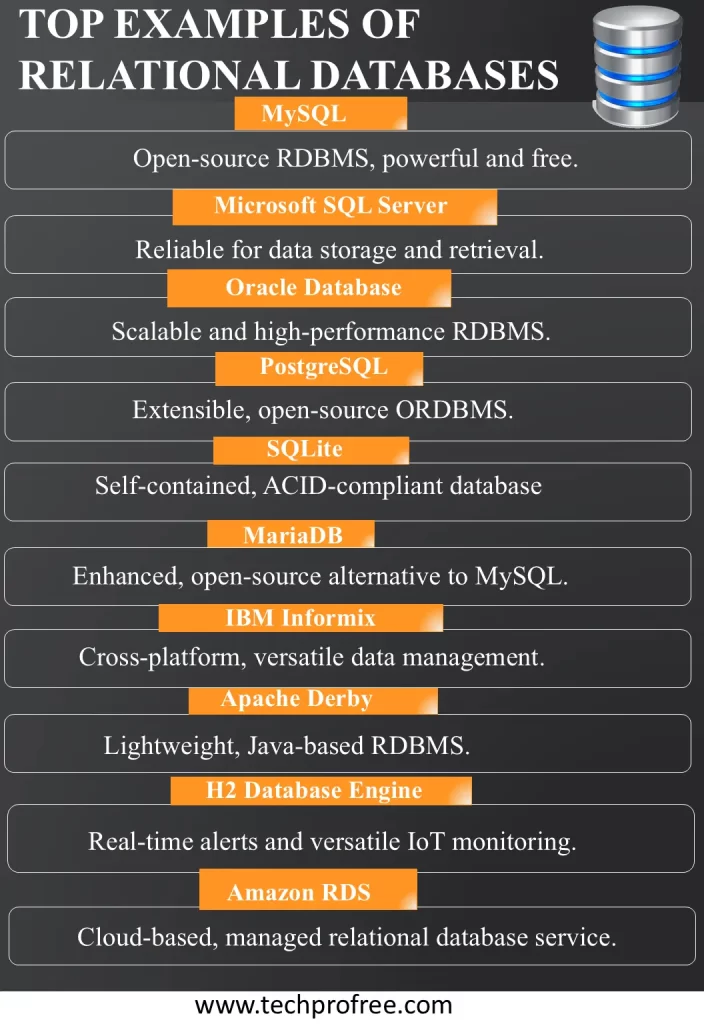
This section comprises a summary of some significant relational database management systems examples in the digital society.
-
MySQL
MySQL is an open-source RDBMS widely used; it runs under the General Public License (GNU) and several proprietary licenses. It provides strong data management functionalities. At the same time, it is available free of cost.
-
Microsoft SQL Server
Microsoft SQL Server is an RDBMS developed by the Microsoft organization and utilized for data storage and retrieval from software applications, whether local or distributed across networks.
-
Oracle Database
Oracle Database, created by the company named Oracle Corporation is a popular RDBMS due to its scalability, reliability and performance. It works in the major platforms of Linux, UNIX and Windows accommodating multiple organizational needs.
-
PostgreSQL
It is known as Postgres. It can be regarded as ORDBMS; this means that the main focus of such software is to provide extensibility along with conformity. Its open-source character under the PostgreSQL License highlights the accessibility and adaptability of this software.
-
SQLite
The C programming library also includes SQLite; a self-contained RDBMS, without the client-server architecture. It has a wide distribution over browsers, operating systems and embedded systems with ACID compliance along with rich SQL support.
-
MariaDB
MariaDB, an open-source relational database management system developed by MySQL originators is compatible with the latter while having additional functionalities. Its widespread adoption cuts across the different sizes of organizations due to its versatility and scalability.
-
IBM Informix
Informix, a product introduced in 1982 is one of the oldest commercial RDBMS products that have been acquired by IBM. Its ability to work in different platforms highlights its historical importance and continued relevancy.
-
Apache Derby
Apache Derby, created by the Apache Software Foundation, is a relational database management system (RDBMS) designed to be easily incorporated into Java-based applications to support online transaction processing. Java-based Apache Derby becomes a lightweight and flexible open-source RDBMS, designed for the development of small scale databases or prototypes due to its usability.
-
H2 Database Engine
H2 is an SQL database engine written in Java™ and provides the implementation of the JDBC API. It includes a browser-based console application for user convenience. Additionally, it’s noteworthy that the H2 database comes pre-installed with the Curam software suite. Another Java-oriented RDBMS, H2 Database Engine is simple and provides rich features for embedded or server deployment which makes it a good choice as a small application use like prototype.
-
DB2
IBM DB2 accommodates a range of the hybrid data management solutions that address different workloads from transactional processing to analytics. Its attributes focus on performance tuning and scalability in multiple data environments.
- Amazon Relational Database Service (Amazon RDS)
It is imperative to acknowledge that Amazon RDS constitutes a distributed relational database service offered by Amazon Web Services. Operating as a cloud web service, the main goal is to facilitate the configuration, management and scalability of relational databases used within applications.
One of the few notable managed relational database services that allow for deployment and scaling of popular RDBMSs like MySQL, Postgre SQL Maria DB, Oracle or MSSQL in cloud infrastructure is Amazon Relational Database Service (Amazon RDS).